
US could commit ‘mass atrocities’
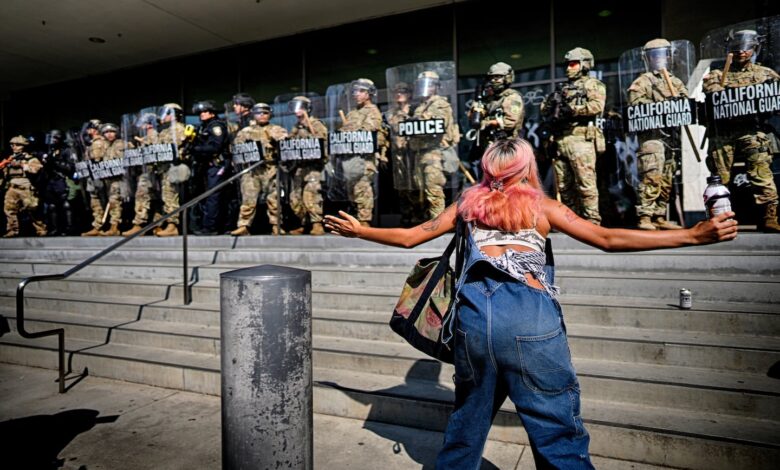
“Things like cracking down on the right to protest, the large-scale use of police repression — particularly ICE and its targeting of immigrant communities — the illegal extrajudicial killings of civilian boats off the coast of Venezuela,” Mark said.
While some recent events can be attributed to President Trump’s policies, the researchers said, human rights have been on the decline in the US for decades.
“We can trace the decline of human rights in the US back to the War on Terror and Patriot Act,” Mark said.
In the 2024 report, the US received a “D” for human rights, ranking 66th globally for its human rights practices.
But this year’s report did not rank nations or assign a grade; Mark said data the researchers relied upon, from annual reports on other countries compiled by the US State Department, was not available after the reports were dramatically changed this year.
The State Department called the reports “streamlined,” but human rights groups said they omitted significant human rights abuses such poor prison conditions and gender-based violence.
“The reports that they put out this year are useless,” Mark said. “They’ve been politicized. … So we came to the conclusion that they cannot be used to evaluate human rights anymore.”
He said the US would likely be down to an “F” for 2025, if the researchers had graded countries this year.
“There’s very little question of that,” Mark said. “Human rights are worse today than they were a year ago.”
Multiple organizations track human rights violations across the globe, include Amnesty International and Human Rights Watch, and the researchers will continue to use data from those groups moving forward, Mark said, and hopefully will be able to rank countries again in next year’s report.
But the list of nations at risk of committing mass atrocities was a new addition to this year’s report, using data from the CIRights Project, a collaboration between URI and Binghamton University.
The researchers looked at 40 years of data to see what the precursors were before countries committed mass atrocities.
In addition to the US, the other countries listed at risk of committing mass atrocities are Bangladesh, Brazil, Burundi, China, Democratic Republic of the Congo, Egypt, Ethiopia, India, Iran, Iraq, Israel, Kenya, Libya, Nicaragua, North Korea, Pakistan, Philippines, Russia, Saudi Arabia, Somalia, South Sudan, Syria, Venezuela, and Yemen.
The list is meant to act as a warning flag, not a predictor, Mark noted. The US has freedoms that some other countries on the list do not, including an independent judiciary and democratic elections, making it less likely to commit atrocities such as mass killings of civilians.
“I don’t want to be too alarmist,” Mark said. “There are a lot of opportunities to walk this back.”
Roya Izadi, the associate director of the Center for Nonviolence & Peace Studies, said researchers also found society across the globe is becoming more militarized. Military personnel were used for domestic security and curfew enforcement during COVID-19 for example, Izadi said, but in some places “they never left,” she said. “And that’s alarming.”
In the US, the military is being deployed to quell protests or support immigration enforcement, Izadi said, a warning sign of a shift toward societal militarization.
In 2024, when the project ranked countries, the top five countries for human rights were Iceland, Estonia, Denmark, Finland, and Monaco.
While some Americans support the immigration policies or other actions criticized as human rights violations in the report, Mark said the goal is to push people to think hard about when it makes sense to curb personal freedoms in the name of national security.
“Most of our research says doing this actually will harm the country,” Mark said. “It will harm our economy, it will harm our standing internationally, and will actually make us less safe.”
Steph Machado can be reached at steph.machado@globe.com. Follow her @StephMachado.


